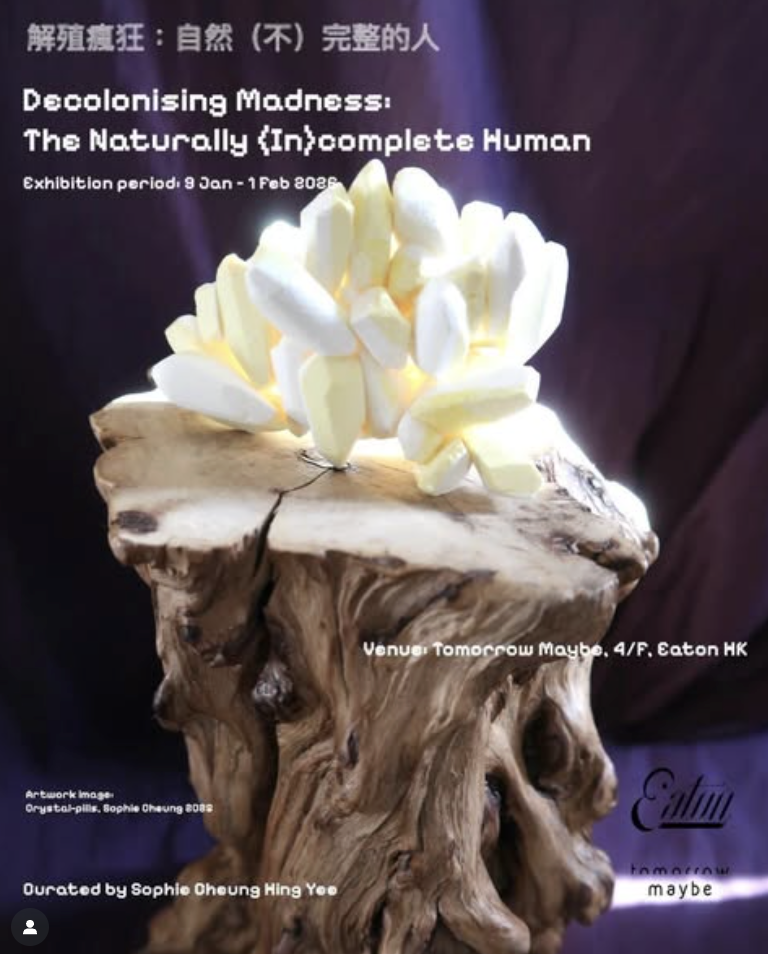
「解殖瘋狂:自然(不)完整的人」張馨儀個人展覽
簡介
In a world that labels systemic failures and its normality as “madness,” we choose to respond by delving deeply into the laws of nature: every life is, by its very essence, (in)complete.
This exhibition critiques the legal concept of “mental incapacity” and the systems that measure legal capacity and subjectivity. Artist Sophie Cheung adopts “dis-identification” as method—neither fully accepting nor rejecting labels like “disability” or “recovery,” but strategically reclaiming and reassembling them. Through ten years of community art workshops in Hong Kong and London, she and participators forged excluded experiences into raw material for creating “life” as the ultimate artwork. The show reveals how, at the margins of discipline, each of us can find vibrant ways of becoming ourselves.
“The Naturally (In)complete Human” evokes an authentic (in)completeness, exposing how legal “mental (in)capacity” violates our natural state. Western “natural law” stems from divine ideals of order, yet true nature has no tangled labels—only endless transformation and flowing energy.
A withered tree is not “dead” but a hub sheltering new life; winter branches are reservoirs of strength. Trees do not judge each other “disabled”—they coexist, sharing nutrients in unconditional symbiosis. When we return humans to life's interconnected web, many “personal problems” reveal themselves as signs of systemic imbalance.
Thus, the title playfully parodies “the mentally incapacitated person.” It offers no new “truth,” but a fluid, nature-like understanding: dissolving the permanence of labels. Every marked life state is a node of transformation in an unconditional ecological network—not seeking another “completeness,” but living at the edge of definition, in creative uncertainty.
製作/參與人員