Overview
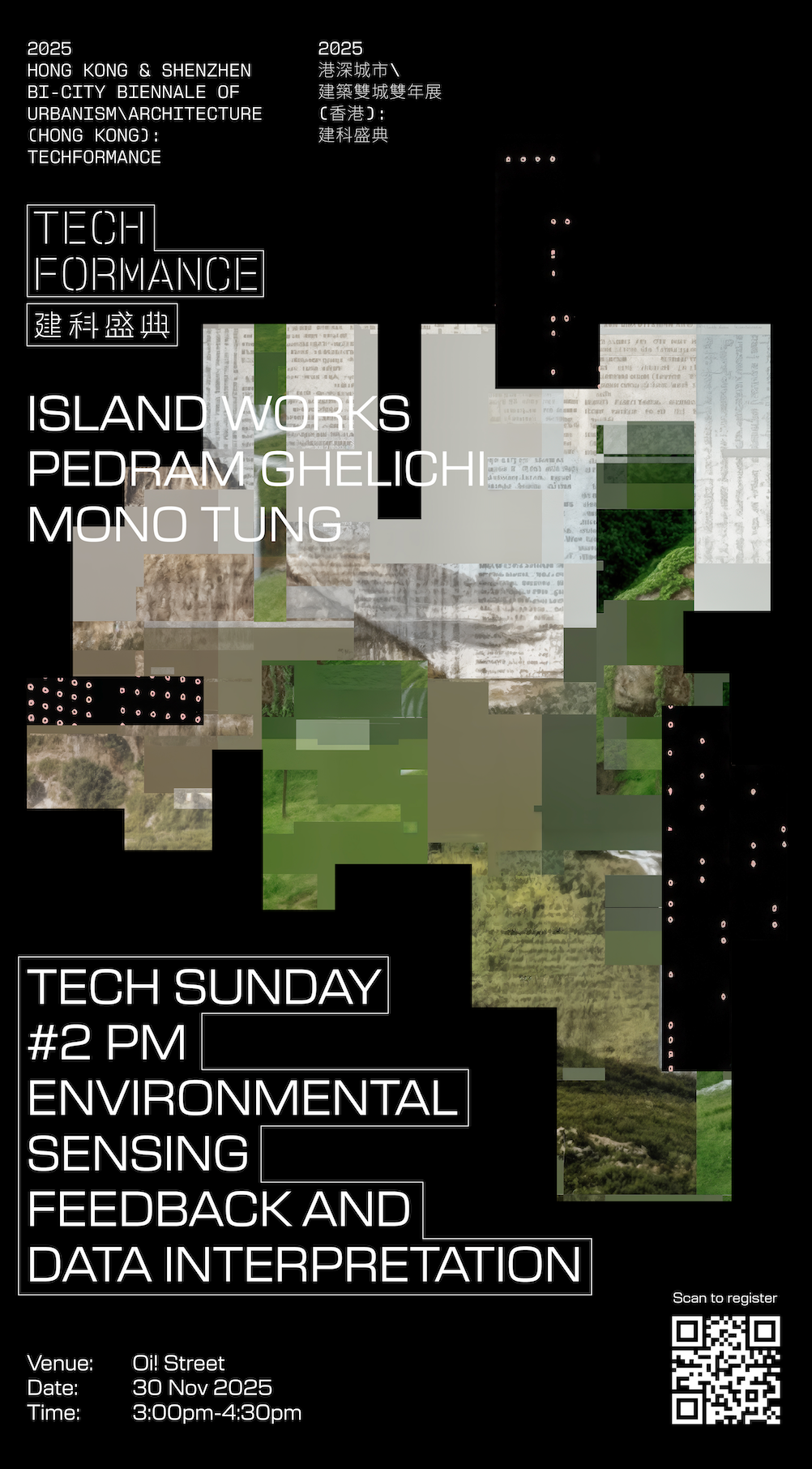
Tech Sunday is a series of small forums organised by the UABB curatorial team 2025 on weekends. Each forum presents curated topics by the participating exhibitors, and we invite the public to take part in the intellectual exchange. Participants will understand the speaker's background, the body of work and the design intention behind the exhibit through each talk.
This session explores how environmental and social dynamics can be narrated through visual and data-driven storytelling, with projects leveraging AI for pattern detection, data visualization, and participatory actions.
Topics:
1. Nature in the Digital Era: Transforming Hong Kong's Coastline through Mechanical Visualization ( Speaker: Island Works )
2. Adaptive furniture system integrating AI-powered pose tracking and public data collection to enhance ergonomic and social interactions in urban spaces ( Speaker: Pedram Ghelichi )
3. Soft Assemblies: Modular Air Structures and Collective Learning in Chuen Lung ( Speaker: Mono Tung )
4. Discussion + Q&A
Language: English
Speakers:
Island Works
Island Works is a Hong Kong–based research and design collective co-founded by architects Chi and Leroy. The practice is driven by a sustained inquiry into the city's 200+ surrounding islands—landscapes often overlooked within the dominant narrative of dense urbanisation yet integral to Hong Kong's geographical and cultural identity.
Working through a cyclical methodology of discover, document, design, Island Works approaches islands as both archival subjects and speculative grounds. Research and first-hand digital documentation underpin an evolving repository that seeks to preserve the essence of each island.
This research extends into a design language that regards islands not only as geological phenomena but also as cultural and infrastructural artefacts shaped by memory, time, and imagination. Through this lens, Island Works advances speculative futures, translating its findings into interventions such as site-specific installations that reframe islands as sites of design imagination.
Pedram Ghelichi
Pedram Ghelichi is a Lecturer in Architecture at The Chinese University of Hong Kong. He earned his PhD from CUHK in 2021, exploring uncertainties as creative components of architectural processes, and served as a Visiting Scholar at ETH Zurich. As Head of vve Lab, he leads cross-disciplinary design–build research on adaptable urban furniture and transformable installations featured in Hong Kong, Shanghai, Antwerp, and beyond. Pedram co-investigates projects supported by grants in circular construction and community-led design for disassembly. His recent work encompasses AI-assisted participatory prototyping and was showcased at the ICSA 2025 Critical Practice session in Antwerp.
Mono Tung
Assistant Lecturer in Architecture | Architectural Designer | Art & Technology Researcher | Architecture Columnist
Mono Tung is an architectural designer working at the intersection of architecture, art, and technology. He is currently an Assistant Lecturer at the University of Hong Kong, specializing in computational architectural design, digital fabrication, and robotic construction. He has worked at Zaha Hadid Architects and Foster + Partners, contributing to international architectural and artistic projects that explore interactive architecture and digital craftsmanship.
As an architecture columnist for Ming Pao, he examines how technology is shaping the future of architecture. His spatial designs and installations, created in collaboration with local contemporary artists, have been showcased at major international festivals, including the Echigo-Tsumari Art Triennale, Singapore Art Week, and Landskrona Foto Festival in Sweden.
He is also dedicated to the open sharing of digital architectural resources, leading the establishment of Hong Kong's architectural archive, which documents the city's transformation through photogrammetry and 3D modeling. His research and teaching explore how architecture can respond to its environment and human interaction, transforming spaces into dynamic and adaptive experiences, with a particular focus on innovative applications of inflatable architecture in contemporary spatial design.
Production / Artist